Last reviewed: November 2026 | Reviewed by the FounderTools Editorial Team
Most founders don't have a document problem. They have a sequencing problem.
They sit down to "write their pitch deck" and end up drafting a 40-page business plan nobody asked for. Or they write a beautiful strategy memo for investors when what the investor actually wanted was a one-page teaser they could forward to a partner in ten seconds. The documents themselves aren't wrong — they're just aimed at the wrong reader, at the wrong moment, in the wrong order.
This guide organizes the founder's document stack around a simpler question than "what should I write?" The right question is: who reads this, and what decision are they trying to make when they do? Answer that, and the right document — and the right length, tone, and level of detail — follows almost automatically.
If you're building this stack yourself, the tool pages linked throughout — starting with pitch deck generation, fundraising strategy, and investor readiness — handle the execution once you know what to write and why.
By the end, you'll know which of these documents you actually need at your current stage, in what order to build them, and how to keep them from going stale as your company changes.
What Is the Founder's Document Stack?
Definition and context
The founder's document stack is the set of written artifacts a startup produces to communicate its strategy — to investors, to its own team, and to itself. In practice, it's a small, deliberately organized library that serves three distinct audiences: external fundraising documents (one-pager, pitch deck, executive summary, business plan), internal alignment documents (mission/vision/values, strategy memos, PRDs, go-to-market strategy), and legal/operational documents (founders' agreement, cap table, IP assignment — a related but separate cluster from the strategy documents covered here).
Most existing advice treats these as a flat checklist: "here are the documents startups need." That framing causes the exact confusion founders run into — writing a business plan when a one-pager would have worked, or treating a pitch deck as if it doubles as an internal operating document. The useful organizing principle isn't a list. It's audience and stage.
Who this applies to
This applies to any founder who has to explain the company in writing — which is every founder, starting well before the first outside dollar comes in. Pre-seed founders need at minimum a one-pager and the beginning of a pitch deck. Founders past Series A need the fuller stack: deck, strategy memo, financial model, and internal alignment documents that keep a growing team pointed in the same direction. The stack grows with the company; it doesn't appear all at once.
Why the Document Stack Matters for Founders
A document is a compression tool. You know far more about your business than any reader has time to absorb, so every document you write is really a decision about what to leave out. Get that decision wrong and one of two things happens: the reader disengages because you gave them too much, or they walk away with the wrong impression because you gave them too little of the right thing.
This matters more than it seems, because different readers fail in different ways. An investor skimming a cold email will discard anything longer than a screen's worth of text — so a rambling three-page teaser costs you the meeting before it starts. A co-founder trying to make a hard prioritization call needs more than a slide's worth of context — so a slide deck used as an internal alignment tool leaves the real reasoning undocumented, and the team ends up re-litigating decisions that were supposedly already made.
The cost of getting the stack wrong isn't cosmetic. It shows up as fundraising meetings that never get booked, internal debates that never actually resolve, and a business plan that took three weeks to write and that nobody — investor or employee — ever reads again.
The Core Framework: The Document Stack Matrix
Rather than a list, use a matrix with two axes: audience (investor, team, self) and purpose (test interest, tell the story, align execution, formalize for diligence). Every document in the stack sits in exactly one primary cell. If you can't say which cell a document belongs in, that's usually the sign you're about to write the wrong thing.
| Document | Primary Audience | Purpose | Typical Length | When You Need It |
|---|---|---|---|---|
| One-pager | Cold investor, referral contact | Test interest fast | 1 page, ~90-second read | Before any outreach — pre-seed onward |
| Pitch deck | Investor, in a live meeting | Tell the story, drive a decision | 10–20 slides | Once a meeting is booked |
| Financial model / forecast | Investor (later diligence), yourself | Show the math behind the story | Spreadsheet + summary page | Seed onward, mandatory by Series A |
| Strategy memo ("state of the business") | Investor (Series B+), leadership team | Align on where the company stands and where it's going | 2–6 pages, narrative | Quarterly/board cadence, Series A onward |
| Executive summary | Formal application, grant body, lender | Summarize for due diligence | 1–2 pages | Only when specifically requested |
| Business plan | Lender, grant body, occasionally a very traditional investor | Formal, exhaustive documentation | 20–50 pages | Rarely, and only on request |
| Mission/vision/values (MVV) | Team, future hires | Set cultural and decision-making context | 1 page | Founding, revisited at each major inflection |
| Go-to-market strategy | Team (marketing, sales, product) | Connect customer, positioning, and channel | 2–5 pages | Before first real launch push |
| PRD (product requirements doc) | Product/engineering team | Align on what's being built and why | Varies by team | Ongoing, per major feature/initiative |
Practical breakdown
Notice what the matrix makes visible that a flat list hides. Three of these documents — one-pager, pitch deck, financial model — exist to move an investor through a funnel: interest, meeting, diligence. Two — executive summary, business plan — exist almost entirely for formal processes outside venture fundraising: banks, grant committees, occasionally a more traditional or growth-equity investor who explicitly asks for one. The remaining four — strategy memo, MVV, go-to-market strategy, PRD — aren't investor documents at all. They're how the company talks to itself.
That last group is the one most founders under-invest in, because it produces no external validation. Nobody funds you for having a good mission statement or vision statement. But it's also the group whose absence causes the most expensive internal confusion later. Co-founders discover they've been operating from different mental models of the strategy, months after the decision was supposedly made.
What to watch for
The most common structural mistake is treating the pitch deck as the master document and trying to make every other document a version of it. A deck is built to be presented, with a narrator filling gaps between slides. A one-pager, a strategy memo, and a business plan all have to stand alone on the page with no narrator — which means they need different internal logic, not just a different length. Cutting a 15-slide deck down to one page doesn't produce a good one-pager. It produces a deck with the narration missing.
The Founder's Document Stack Framework: A Step-by-Step Sequencing Model
This is the original framework at the center of this guide. It answers one question in order: given your current stage, what should you build next, and why? Use it as a standalone checklist — you don't need the rest of this article to run it.
-
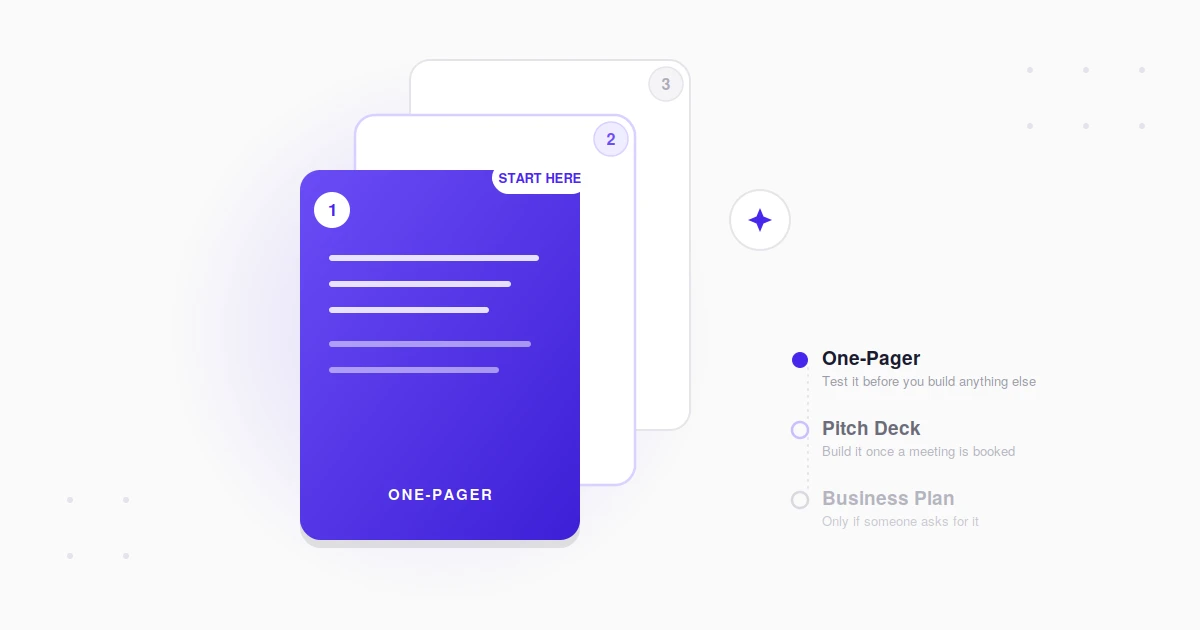
Write the one-pager first. Before you build anything else, force yourself to state the company in one page: overview and unique value proposition, problem, solution, target market and TAM, traction and milestones so far, team credentials, and — if you're raising — the ask and use of funds. A tool like the AI value proposition generator can help you sharpen the "solution" section before you commit it to the page. If you can't compress the business into these seven pieces, you don't yet understand it well enough to pitch it.
-
Test the one-pager before building the deck. Send it to a handful of people whose reaction you trust — advisors, warm investor contacts, other founders. If it doesn't generate a "tell me more," fix the one-pager before you invest a week building slides around it.
-
Build the pitch deck for the meeting, not the inbox. Once someone has agreed to a call, build 10–20 slides that walk through problem, solution, market sizing (TAM/SAM/SOM), business model, traction, team, and financial projections — enough to drive a live 20–30 minute conversation, not to be read cold. The AI pitch deck generator can help you structure this from your existing one-pager content.
-
Build the financial model alongside the deck, not after it. Your traction slide and your ask are only as credible as the model behind them. The AI financial projection generator is useful for putting a first-pass model together quickly. Investors who move to diligence will ask for this immediately; not having it ready is a stage-inappropriate gap, not a minor omission.
-
Write your first internal strategy memo once you have a team to align. This doesn't need Amazon's exact six-page structure, but borrow its spirit: state the current state of the business plainly, name the strategic priorities, and write it as prose a reader absorbs silently — not bullets a presenter narrates.
-
Only build the executive summary or full business plan when someone specifically asks for one. If a lender, grant body, or a more traditional investor requests it, extract the executive summary from your existing one-pager and deck content rather than starting from a blank page — most of the material already exists.
-
Revisit the whole stack at every material change, not on a fixed calendar: a new round, a pivot, a new co-founder, or six months of material change to your metrics. A document stack that isn't updated becomes a liability the moment someone reads it and it contradicts reality.
Applied to a real scenario: A two-person B2B SaaS team raising a $1.5M seed round runs this exact sequence. Step 1 produces a one-pager built around 12 paying pilots and $8K MRR. Step 2 surfaces weak TAM framing from three advisors, so they fix it before touching a slide. Step 3 produces a 14-slide deck built only after meetings are booked. Step 6 never triggers — no investor in their process asks for a business plan, so it's never built. The sequence itself is what keeps them from wasting a week on a document nobody requested.
This sequence is a decision model, not generic advice to "have a deck and a one-pager." It tells you the order, the trigger for each step, and the condition under which you skip a step entirely (steps 6 applies only on request).
Common Mistakes and How to Avoid Them
Writing the business plan first. Founders coming from traditional business backgrounds default to the business plan because it feels the most "complete." For a VC-track SaaS startup, this is usually wasted effort — a startup is a search for a repeatable, scalable business model, not the execution of a known one, and a 40-page plan documents certainty you don't have yet. Default order: one-pager, then deck, then plan only on request.
Sending the deck cold. A deck is built assuming a narrator fills the gaps between slides. Sent cold, it reads as disjointed or over-designed. Use the one-pager for cold outreach and save the deck for a booked meeting.
Treating the deck as the internal source of truth. Slide decks compress reasoning into bullets; they're built to persuade in a room, not to preserve the "why" behind a decision. If your only internal record of strategy is last quarter's fundraising deck, expect your team to disagree about what was actually decided.
Skipping the financial model until an investor asks. By the time an investor asks for the model, you're already in diligence and the clock is running. Build it in parallel with the deck, even in simplified form.
Letting documents go stale. A pitch deck with a metrics slide six months out of date is worse than no metrics slide — it signals you're not tracking your own numbers closely. Assign an owner and a trigger (funding round, board meeting, material metric change) for updating each document, not a "someday" intention.
Writing a business plan or executive summary nobody requested. Both are due-diligence and formal-application documents, not outreach tools. Building them speculatively is usually time better spent refining the one-pager and deck that will actually get you the meeting.
Examples and Case Studies
Illustrative example — a seed-stage SaaS founder. A two-person B2B SaaS team preparing to raise a $1.5M seed round starts with a one-pager: the problem (manual invoice reconciliation for mid-market finance teams), the solution (an automation layer), traction (12 paying pilot customers, $8K MRR), and an ask ($1.5M for 18 months of runway). They test it on three advisors, tighten the TAM framing based on feedback, then build a 14-slide deck for the meetings the one-pager generates. They do not write a business plan — no investor in their process asks for one, and the one-pager plus deck plus a simple financial model cover every conversation through term sheet.
Illustrative example — a Series A team building internal alignment. A 20-person startup post-Series A finds that engineering, sales, and the CEO have three different mental models of the next two quarters' priorities. Rather than another slide deck, the CEO writes a four-page strategy memo — narrative, not bullets — covering current state of the business, lessons from the last quarter, and the top three strategic priorities. It's read silently at the start of the next leadership meeting, the way Amazon's internal six-pager is used, before any discussion starts. The disagreement surfaces in minutes instead of weeks, because the reasoning — not just the conclusion — is finally written down somewhere everyone can point to.
These are illustrative scenarios built to show how the framework applies in practice, not documented case studies of named companies.
Tools to Accelerate the Process
Building each document from a blank page is where most of the wasted time goes. A structured template — one that already encodes the right sections for a one-pager versus a strategy memo versus a pitch deck — removes the first, hardest hour of any of these documents: deciding what belongs where.
If you're about to start on your own document stack, it's worth working from a founder-specific outline for each document type rather than a generic business-writing template, since the sections that matter (TAM/SAM/SOM framing, use of funds, traction metrics) are specific to how startups get evaluated, not how businesses in general get evaluated. Relevant starting points include the AI pitch deck generator for the deck, the AI financial projection generator for the model, the AI business model canvas generator for clarifying the underlying business logic before you write, and the AI go-to-market strategy generator for the go-to-market document in the internal stack.
Advanced Strategies
Build a living "master doc" behind the stack. Once you have a one-pager, deck, and strategy memo, maintain one internal source-of-truth document — metrics, positioning language, team bios, and the current strategic priorities — that every external document gets extracted from. This keeps your one-pager, deck, and any executive summary consistent with each other instead of quietly drifting apart as you update one and forget the others.
Match document cadence to company velocity, not the calendar. Early-stage strategy memos might need monthly updates because the business model itself is still moving. Post-Series A, quarterly is usually enough, tied to your board cadence. Update triggered by material change (new round, pivot, key hire) always overrides a fixed schedule.
Use the strategy memo as your board-meeting spine. Rather than building a new deck for every board meeting, send the memo in advance for silent reading, and use the meeting time for discussion — the model TechCrunch describes as part of the founder's "holy trinity" for later-stage fundraising: the deck, the strategy memo, and the forecast. This shifts board meetings from status-reporting theater to actual decision-making time.
Separate your fundraising stack from your legal stack deliberately. Founders' agreements, cap tables, ESOP documentation, and IP assignment agreements are a related but distinct set of documents from the strategy stack covered here — don't let a diligence request for legal documents pull you into rewriting your strategy documents at the same time. Keep the two workstreams separate so a legal review doesn't stall your fundraising narrative.
Conclusion
The founder's document stack isn't a checklist to complete once. It's a small set of tools, each built for a specific reader and a specific decision, that you build in order — one-pager, then deck, then financial model — and revisit as the company changes. The business plan and executive summary sit at the edges of this stack, useful only when a specific formal process calls for them, not as a default starting point. The documents that most founders under-build — the strategy memo, the MVV statement, the go-to-market strategy — are the ones with no external audience to demand them, which is exactly why they're worth building deliberately rather than skipping.
Start with the one-pager. If it can't survive a 90-second read from someone who doesn't know your business, nothing built on top of it will hold up either. For related steps in the fundraising process, see our guides on investor readiness and fundraising strategy.
Frequently Asked Questions
Do I need a business plan if I already have a pitch deck (or vice versa)?
Usually not both, and rarely a full business plan at all. A pitch deck is built for a live investor meeting; a business plan is a formal document for lenders, grant bodies, or diligence processes that explicitly request it. Most VC-track SaaS founders can raise an entire round on a one-pager, a deck, and a financial model, and never need to write a formal business plan.
Should I build my pitch deck or my business plan first?
Neither — build the one-pager first to test whether your framing generates interest, then build the pitch deck once a meeting is booked. Only build a business plan afterward, and only if a specific investor, lender, or grant process asks for one by name.
What's the actual difference between a one-pager, an executive summary, and a pitch deck — don't they cover the same info?
They cover overlapping content but serve different moments. The one-pager is for cold outreach and must work with no narrator in under 90 seconds. The pitch deck is built to be presented live, with slides that rely on you talking through the gaps. The executive summary is a 1–2 page narrative extracted from a fuller business plan, used mainly for formal applications and due diligence rather than initial outreach.
Can I just use my pitch deck as an internal strategy/planning document?
Not effectively. A deck compresses reasoning into bullets designed to be narrated; it strips out the "why" behind decisions. For internal alignment, a narrative strategy memo — closer to Amazon's six-pager format — preserves the reasoning your team will need to refer back to later.
How long should each of these documents be, and how often should I update them?
One-pager: one page. Pitch deck: 10–20 slides. Strategy memo: 2–6 pages. Executive summary: 1–2 pages. Business plan: 20–50 pages, built only on request. Update on triggers — new funding round, pivot, key hire, or material change in metrics — rather than on a fixed schedule; quarterly is a reasonable default cadence once you're past Series A.
Which document do I send cold to an investor vs. bring into a meeting vs. share only after they ask for more detail?
Cold: the one-pager. Booked meeting: the pitch deck. After they ask for more: the financial model, and only if specifically requested, an executive summary or business plan.
Do I really need a full business plan, or is it a waste of time for a VC-backed tech startup?
For most VC-backed SaaS startups, yes, it's largely unnecessary as a fundraising document. It's better understood as a legacy artifact from bank-loan underwriting. Build one only if a lender, grant committee, or a specific investor asks for it directly — otherwise, the time is better spent refining your one-pager, deck, and financial model.
What internal documents beyond fundraising materials do I need to keep my team aligned as we grow?
A mission/vision/values statement, a go-to-market strategy document, and a recurring strategy memo are the core internal set. Add PRDs once you have a product team, to keep engineering and product aligned on what's being built and why.
What should go into a strategy memo versus a pitch deck?
A pitch deck tells a persuasive story built around slides and a live narrator. A strategy memo documents the current state of the business, lessons learned, and strategic priorities in prose that stands alone — meant to align a team or board on reasoning, not to persuade a room in one sitting.
Which of these documents actually matter for early-stage versus later-stage fundraising?
Pre-seed and seed: one-pager, pitch deck, and a basic financial model are usually sufficient. Series A: add a more rigorous financial model and your first internal strategy memo. Series B and beyond: the "holy trinity" of deck, strategy memo, and forecast becomes standard, with business plans and executive summaries appearing only for specific formal requests, not as default fundraising collateral.
Sources
This guide draws on commonly cited startup-document frameworks, including: the standard one-pager structure (overview/UVP, problem, solution, market/TAM, traction, team, ask) used across investor-facing outreach guides; the 10–20 slide pitch deck structure covering problem, solution, TAM/SAM/SOM, business model, traction, team, and financials; Amazon's internal "6-pager" narrative memo format, introduced by Jeff Bezos in 2004, used for silent-reading alignment at the start of meetings; and TechCrunch's framing of the founder's "holy trinity" of later-stage fundraising documents — the deck, the strategy memo, and the financial forecast. Company examples used in this article are illustrative composites, not documented case studies of named companies.
The Rest of the Stack: Tools for Every Stage
Beyond fundraising documents, the founder's document stack extends into the strategic thinking that has to happen before any of them get written. Each stage in the sequence above has a dedicated tool: validate the idea first with the AI Startup Idea Validator, then map the business model with the AI Business Model Canvas Generator and stress-test it with the AI SWOT Analysis Generator. Once you know who you're building for, the AI Buyer Persona Generator and AI Value Proposition Generator sharpen the positioning that feeds directly into your one-pager and deck narrative.
Before pricing or go-to-market decisions harden into a plan, the AI Competitor Analysis Generator, AI Pricing Strategy Generator, and AI Go-To-Market Strategy Generator turn assumptions into a defensible strategy section. As the product itself takes shape, the AI MVP Planner and AI Product Roadmap Generator keep the build sequence honest and investor-legible.
On the numbers side, the AI Financial Projection Generator and AI Startup Valuation Calculator give you the model your pitch deck and data room both need to agree with. And once you're assessing whether you're actually ready to raise, the AI Investor Readiness Assessment is a useful gut-check before you open the AI Fundraising Strategy Generator or start building slides in the AI Pitch Deck Generator.