Every founder eventually hits the same wall. The idea is real, the market is real, maybe you even have a waitlist or a first customer — and you still cannot answer the one question everyone asks first: "What's it called?"
Choosing a business name feels like it should be the fun part. In practice, it is one of the highest-leverage — and most consequential — decisions a founder makes before writing a single line of code or signing a single lease. A name is the first thing a customer, investor, or hire ever encounters about your company. It shapes trust before you say a word, decides whether people remember you after a five-second glance, and quietly influences your SEO, your domain options, and how easily people can talk about you to a friend.
This guide is the complete, no-fluff playbook for getting it right in 2026 — grounded in what actually works, not naming folklore. We will walk through why names carry so much weight, the traits every strong name shares, the seven proven types of names to choose from, a step-by-step framework you can run this week, the mistakes that quietly sink founders, and how AI-assisted naming compares to the old-school whiteboard brainstorm.
Quick Decision
Building your first startup?
→ Jump to “The 10 Characteristics of Great Business Names”Renaming an existing business?
→ Go to the Step-by-Step Naming FrameworkComparing AI naming tools?
→ Visit the Comparison Hub sectionLooking for practical examples?
→ Read the Common Naming Mistakes section
Why Business Names Matter
It is tempting to treat naming as a formality — something to get out of the way so you can move on to "real" work like building the product. That instinct is understandable, but it undersells what a name actually does inside your business.
Psychology: names create a first impression before anything else does
Human brains form snap judgments in milliseconds, and a name is often the very first data point a person receives about your company — before your logo loads, before your pricing page appears, before they read a single sentence of your pitch. A name that sounds credible, warm, technical, or premium primes the reader to interpret everything that follows through that lens. This is called a "framing effect," and it works whether you intend it to or not.
Trust: an unclear or awkward name creates hesitation
Customers rarely articulate it consciously, but a name that is hard to pronounce, hard to spell, or oddly generic creates a small amount of friction — a half-second of "wait, what was that called again?" That friction compounds across every touchpoint: word-of-mouth referrals, search queries, App Store listings, even typing your URL from memory. A clean, confident name removes that friction entirely.
Brand recall: memorable names get repeated
Referrals are still the highest-converting acquisition channel for most early-stage companies, and referrals depend entirely on people remembering your name accurately enough to say it out loud or type it into a search bar. A name that is distinctive and easy to recall gets repeated correctly. A name that blends into a sea of similar-sounding competitors gets forgotten, mispronounced, or confused with someone else.
SEO: your name is your most important keyword, whether you plan it or not
Once you launch, your business name becomes a search term people type directly into Google — often more valuable traffic than any generic keyword you could target, because someone searching your exact name is already looking for you. A name that is unique enough to rank on page one for itself (and not buried under a hundred unrelated results) is a genuine SEO asset. Overly generic names lose this advantage entirely.
Growth: your name has to survive where the business is going, not just where it is today
The name you choose at the idea stage has to work at Series A, at acquisition, and possibly at IPO. A name that only makes sense for your current product ("QuickInvoice") can quietly cap your ambitions the moment you expand into adjacent products. The strongest names give a business room to grow into categories nobody has thought of yet.
A name will not save a mediocre business. But a weak name puts a permanent tax on every growth channel you touch — referrals, SEO, fundraising, hiring. Get it right once, and it compounds in your favor for years.
See it in action
Weak: Tech Solutions International Limited
Better: Stripe
Weak: Online Pet Supplies Company
Better: Chewy
Weak: Global Accommodation Platform
Better: Airbnb
The 10 Characteristics of Great Business Names
Across every strong name we have studied — and every weak one founders have brought us to fix — ten traits separate the names that work from the names that quietly hold a business back.
- 1. Easy to pronounce. If someone cannot say it confidently the first time they read it, they will avoid saying it at all. Good: Notion. Bad: Xhqorix.
- 2. Easy to spell from sound alone. A customer who hears your name on a podcast should be able to type it correctly without guessing. Good: Loom. Bad: Phlurg (sounds like "Flurg," "Flerg," or "Flurgh" depending on the listener).
- 3. Short enough to type without friction. Two to three syllables is the sweet spot for most categories. Good: Stripe, Canva. Bad: The Comprehensive Business Solutions Group.
- 4. Distinctive within your category. If it sounds like five other names in your space, it will get lost — and confused with them. Good: Figma stands apart from Sketch and Adobe XD. Bad: naming your fintech startup "PayFlow" when four competitors already use "Pay-something."
- 5. Emotionally resonant, not just descriptive. The best names create a feeling, not just a literal description of function. Good: Calm (for a meditation app). Bad: MeditationAppPro.
- 6. Available where it counts. A great name that cannot be trademarked or registered as a workable domain is not actually usable, so treat availability as a hard requirement, not a nice-to-have.
- 7. Room to grow into adjacent products. A name should not trap you inside today's feature set. Good: Amazon started as a bookstore and the name never became a liability. Bad: naming your multi-product SaaS "InvoiceGenius" when invoicing is only one of five features.
- 8. Visually simple as a wordmark. Names that are simple to render in a clean logotype age better and design cheaper. Complex names with unusual characters or spacing fight your designer at every turn.
- 9. Culturally safe across your target markets. A word that is neutral in English can carry an unfortunate meaning in another language or region you plan to expand into. A five-minute check saves an expensive mistake.
- 10. Passes the "phone test." Say it out loud on a phone call: "Hi, this is [Name], we help [what you do]." If it sounds natural and confident, it passes. If you stumble or feel the need to spell it immediately, it fails.
FounderTools AI Expert Tip
Run every finalist through all 10 characteristics on a simple checklist before you commit. Most weak names fail on two or three specific traits — usually pronounceability, distinctiveness, or growth headroom — and seeing the failure in writing makes it much easier to let go of a name you have grown emotionally attached to.
Types of Business Names
Every strong business name falls into one (or a blend) of seven proven categories. Knowing which type fits your business — and why — makes brainstorming dramatically more focused.
Descriptive
States plainly what you do. Fast to understand, harder to trademark. Example: General Motors, PayPal.
Invented
A made-up word with no prior meaning. Highly trademarkable, needs marketing to build recognition. Example: Xerox, Google, Spotify.
Compound
Two real words merged into one. Communicates meaning while staying distinctive. Example: Facebook, Snapchat, Basecamp.
Founder
Built on a real person's name. Signals craft and heritage, less scalable for pure tech products. Example: Ford, Dell, Warby Parker's namesakes.
Keyword
Built around the exact term customers search for. Strong for local and SEO-driven businesses. Example: Booking.com, LegalZoom.
Brandable
A short, invented or lightly modified word chosen for sound and feel over literal meaning. Example: Canva, Figma, Asana.
Emotional
Chosen for the feeling it evokes rather than any literal description. Example: Calm, Bliss, Thrive. Strong for wellness, lifestyle, and consumer brands where feeling matters more than function.
Most strong modern names actually blend two categories — a compound name with emotional undertones, or a brandable word with a keyword root. Knowing the seven pure types simply gives you a map to navigate deliberately instead of naming by accident.
| Type | Description | Best For | Example | Potential Risk |
|---|---|---|---|---|
| Descriptive | States plainly what you do. | Local & service businesses | PayPal | Hard to trademark; boxes you into one category |
| Brandable | Short, invented or lightly modified word chosen for sound and feel. | Consumer & SaaS products | Canva | Needs marketing investment to build recall |
| Invented | A made-up word with no prior meaning. | Companies planning to scale into new categories | Slow initial recognition without marketing spend | |
| Compound | A blend of two real words. | Tech & platform businesses | Can feel generic if the words are overused | |
| Founder | Built on a real person’s name. | Craft, professional & heritage brands | Ford | Less scalable for pure tech products |
| Acronym | Shortened initials of a longer descriptive name. | B2B & enterprise businesses | IBM | Meaningless to new customers without context |
| Keyword-based | Uses the exact term people search for. | Local & SEO-driven businesses | Booking.com | Difficult to trademark and to differentiate |
| Emotional | Selected purely for the feeling it creates. | Wellness, lifestyle & consumer brands | Calm | Feeling can fade or misalign as the product evolves |
The Step-by-Step Naming Framework
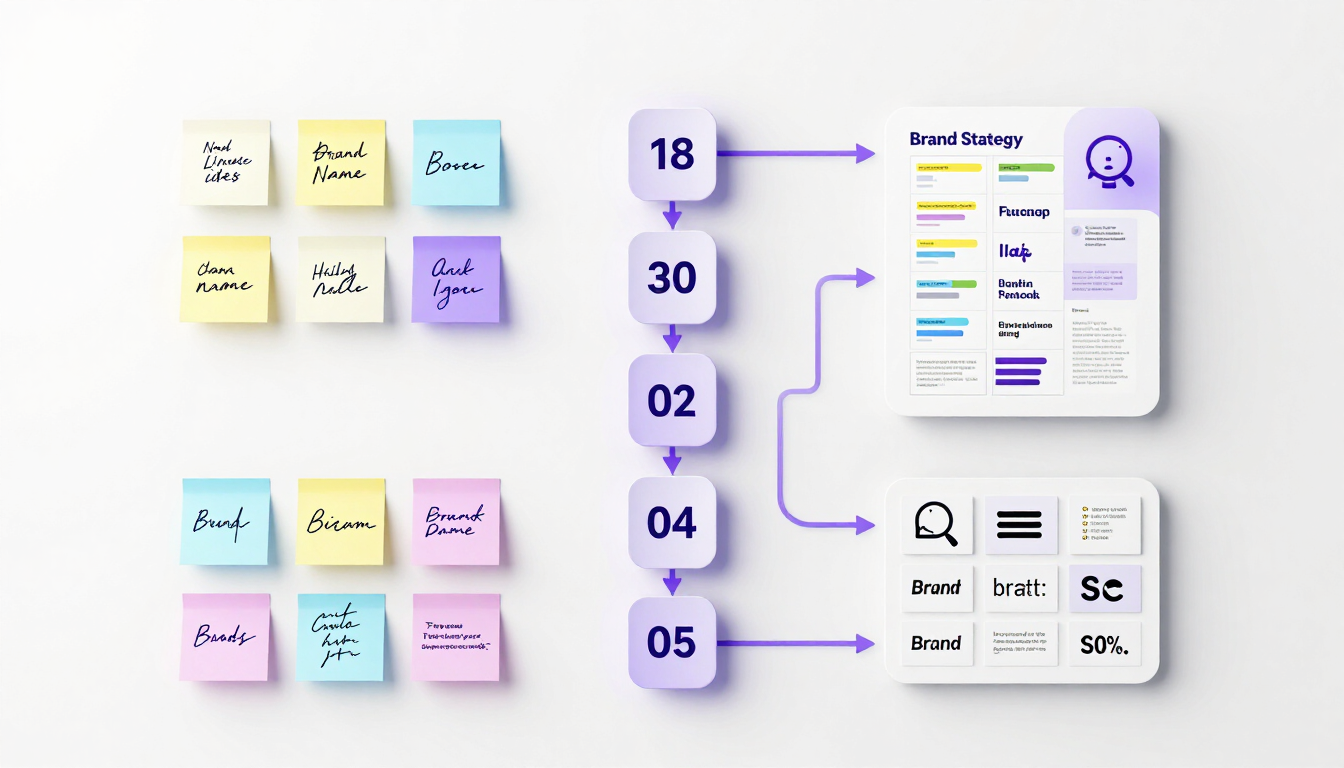
Here is the exact five-step sequence we recommend to every founder — the same sequence built into how our own tools are designed to be used together.
Generate a wide candidate pool
Start with volume, not perfection. Use the Business Name Generator to produce dozens of on-brief candidates in minutes, complete with matching slogans and live domain availability — instead of staring at a blank document for an afternoon.
Stress-test for your specific stage
If you are pre-seed or pre-launch, run your shortlist through the Startup Name Generator to check the candidates against investor-facing criteria — brandability, growth headroom, and how the name will read on a pitch deck two rounds from now.
Pair your finalists with a slogan
A name rarely stands completely alone — it is usually read alongside a tagline. Run your top two or three candidates through the Slogan Generator to see how each name actually performs once paired with real messaging. Some names that look strong alone fall flat next to a tagline; others suddenly click.
Prepare your name for search from day one
Once you have a finalist, use the Meta Title Generator to draft how your homepage will actually appear in Google search results. This surfaces naming problems you would not catch otherwise — names that get truncated, or that read awkwardly next to your core keyword.
Ship structured data so search engines understand your brand
Before launch, use the FAQ Schema Generator to mark up your "What is [Your Name]?" and "How do you pronounce [Your Name]?" questions in structured data. This helps search engines — and increasingly, AI answer engines — describe your new brand accurately from the very first crawl.
Start with the Business Name Generator
Generate 20 unique, on-brief business name ideas with slogans and live domain availability — free, no sign-up required.
Common Naming Mistakes
We have reviewed thousands of founder naming decisions. The same handful of mistakes show up again and again:
- Falling in love before checking availability. Weeks of emotional attachment to a name nobody confirmed you can actually use.
- Naming for today's feature set instead of tomorrow's company. A hyper-specific name that becomes a liability the moment you expand.
- Choosing a name only insiders understand. Clever industry references that mean nothing to your actual customer.
- Ignoring how the name sounds out loud. A name that reads fine in a font but stumbles on a sales call or podcast mention.
- Skipping the trademark search entirely. Discovering a conflict only after you have printed business cards and built a following.
- Copying a naming trend that is already saturated. Being the sixth "-ly" or "Get-something" name in your specific category.
- Letting committee-by-consensus water the name down. A name approved by everyone is often a name nobody feels strongly about.
For the deeper breakdown of each of these — including real before-and-after examples — see our companion guide: Business Naming Mistakes to Avoid.
AI vs. Traditional Brainstorming
The whiteboard brainstorm is not dead, but it is no longer the fastest or most reliable way to reach a strong name. Here is an honest comparison of both approaches.
Traditional brainstorming: strong on nuance, slow and inconsistent on volume
A room of smart people who deeply understand your business can produce genuinely brilliant names — but the process is slow, expensive to repeat, and prone to groupthink. The loudest voice in the room often wins, not the strongest name. And once the energy in the room fades after twenty minutes, so does the quality of the ideas.
AI-assisted naming: strong on volume and pattern-matching, needs human judgment to finish the job
AI naming tools can generate dozens of on-brief candidates instantly, cross-check domain availability in real time, and surface naming patterns a tired team would never think of at 6pm on a Thursday. What AI cannot do is know your market as deeply as you do, sense subtle cultural connotations the way a native speaker can, or make the final judgment call that reflects your actual taste and ambition for the business.
The winning approach in 2026 is not "AI instead of humans" or "humans instead of AI." It is AI for volume and speed, human judgment for the final call. Generate wide with a tool, then filter narrow with your own instincts about the business you are building.
How the AI Name Generators Compare
A handful of AI naming tools have become popular over the past few years, and founders often ask how FounderTools AI stacks up. Here is a brief, honest summary — we go deeper into each comparison in dedicated posts, so this section intentionally stays high-level.
FounderTools AI vs. Namelix
Namelix leans heavily on logo-style brandable names generated with a visual-first approach. FounderTools AI is built for founders who need the full naming-to-launch workflow — names, slogans, domain checks, and SEO metadata — in one connected system rather than a single output.
FounderTools AI vs. Looka
Looka is primarily a logo and brand-kit design tool with naming as a secondary feature. FounderTools AI treats naming as the primary discipline, with dedicated generators for business, startup, brand, and company names rather than one general-purpose tool.
FounderTools AI vs. Shopify Business Name Generator
Shopify's free tool is a solid quick-start for ecommerce sellers who need a fast, simple suggestion. FounderTools AI goes further with slogan pairing, meta title testing, and structured-data generation, aimed at founders building a durable brand rather than a quick storefront label.
FounderTools AI vs. BrandCrowd
BrandCrowd is best known for logo templates with naming as an add-on. FounderTools AI is naming-first and free to start, with no forced upsell into a logo purchase before you can see your name results.
For a full, feature-by-feature breakdown of each comparison — including specific pricing, output quality, and workflow differences — dedicated comparison guides for each tool are coming to the FounderTools AI blog as part of this same Business Naming cluster.
Recommended Business Naming Tools
Every tool below is free to start and built specifically for the naming workflow described in this guide.
Business Name Generator
Generate 20 unique business names with slogans and domain availability checks.
Startup Name Generator
Investor-ready, brandable startup names with .com / .io domain checks.
Brand Name Generator
Premium brand names with brand scores, color palettes, and font pairings.
Company Name Generator
Professional, trademark-aware company names ready to register.
Slogan Generator
20 custom slogan ideas matched to your chosen name and brand voice.
Meta Title Generator
Preview and optimize how your new brand name appears in search results.
Meta Description Generator
Write click-worthy meta descriptions that pair naturally with your name.
FAQ Schema Generator
Mark up your brand FAQ so search engines understand your new name from day one.
If you want the deeper strategic playbook behind professional naming — architecture, trademark strategy, and global considerations — read our Brand Naming Strategy Guide next.
Founder Business Name Checklist
Before you file paperwork, buy a domain, or announce your name publicly, run it through this checklist. It will not tell you which name to pick — that call is still yours — but it will surface the blind spots founders consistently miss when they are emotionally attached to a favorite candidate. Treat every unchecked box as a question to resolve before you make your final naming decision.
Frequently Asked Questions
How long should it take to choose a business name?
Budget one to two weeks if you are doing it properly: a few days to generate and shortlist candidates, a few days to check trademarks, domains, and social handles, and a couple of days to test the finalists on real people. Rushing a name in an afternoon is how you end up with a name you regret in year two — but spending three months on it is just as costly, because every week without a name is a week you cannot register a domain, open a business bank account, or start building an audience.
Should my business name describe what I do?
Not necessarily. Descriptive names (like "Quick Dry Cleaners") are easy to understand immediately but hard to trademark and hard to grow into new categories. Suggestive or invented names (like "Stripe" or "Slack") take a little longer to explain but become far more valuable as the business grows, because they are not boxed in by a literal description. If you are naming a small, hyper-local service business, descriptive can work in your favor for local search. If you are building something you want to scale nationally or sell one day, lean suggestive or invented.
Is it bad if my exact .com domain is taken?
It is a real constraint, but not a dealbreaker on its own. Plenty of strong, well-funded companies operate on .io, .co, .ai, or a slightly modified .com (adding "get," "try," or "use" in front, for example). What matters more is that your domain choice does not confuse people about who you are or make your brand look like an afterthought. If the exact match is taken by an active competitor in your space, walk away from the name — that is a real conflict, not just an inconvenient domain.
What's the difference between a business name and a brand name?
Your business name is the legal entity you register with the state or country you operate in — it is what appears on contracts, tax filings, and your business license. Your brand name is what customers see and say out loud. Many companies operate with both aligned (Nike, Inc. and "Nike"), but plenty of successful businesses run a brand name that differs from their legal entity, registered as a "doing business as" (DBA) or trade name. If you want maximum simplicity, keep them identical. If you want naming flexibility as you grow into new product lines, keeping them separate gives you more room.
Can I change my business name later if I choose wrong?
Yes, but it gets more expensive and more disruptive every month you wait. Early on, a rename means updating a domain, a few social profiles, and some early customer conversations. Two years in with an established customer base, search rankings, and word-of-mouth referrals, a rename means rebuilding brand recognition from close to zero. This is exactly why it pays to get the name right before launch rather than treating it as something you can casually fix down the road.
How many name candidates should I generate before deciding?
Aim for 30 to 50 raw candidates before you start filtering. Most founders stop after 10 and settle for the best of a weak set. A wider pool means your filtering criteria — memorability, availability, pronounceability, and fit — actually get to do their job, because you are choosing the best of many rather than the least-bad of a few. Tools like our Business Name Generator exist specifically to get you to that wider pool in minutes instead of days.
Do I need a trademark attorney to check name availability?
For an initial gut check, no — you can search the USPTO trademark database (or your country's equivalent) yourself for free, along with a basic domain and social handle search. For final clearance before you commit serious marketing spend, a one-time consultation with a trademark attorney is worth the cost. It is far cheaper to pay for an hour of legal review now than to rebrand after receiving a cease-and-desist letter eighteen months from now.
Are invented, made-up names better than real words?
Better is the wrong frame — they solve different problems. Invented names (Spotify, Google, Xero) are highly trademarkable and infinitely flexible, but require marketing investment to build meaning from zero. Real-word names carry built-in meaning and are easier to understand instantly, but are harder to trademark and more likely to already be taken. If you have the budget and patience to build brand recognition over years, invented names compound in value. If you need to be immediately understood with a small marketing budget, a well-chosen real word or compound name gets you there faster.
What role does AI play in naming a business today?
AI naming tools do not replace judgment, but they dramatically compress the time it takes to get from zero candidates to a strong shortlist. A tool like FounderTools AI's Business Name Generator can produce dozens of on-brief candidates, complete with domain availability checks and matching slogans, in the time it would take a human brainstorming session to warm up. The best founders use AI to generate volume and surface patterns they would not have thought of, then apply their own judgment, market knowledge, and taste to make the final call.
What's the single biggest naming mistake founders make?
Falling in love with a name before checking whether it is actually available. Founders will spend weeks attached to a name emotionally, only to discover the domain is squatted, the trademark is contested, or a direct competitor already uses something nearly identical. Check availability early and in parallel with brainstorming, not as the very last step — it saves you from the painful experience of grieving a name you can never actually use.
Founder Naming Worksheet
Answer these seven questions honestly before you register anything. They are designed to surface confusion early, while changing your mind still costs nothing.
- What problem does your company solve?
- Who is your ideal customer?
- Which three words should people associate with your brand?
- Should your name describe your business or create curiosity?
- Will the name still fit if you expand internationally?
- Can someone spell it correctly after hearing it once?
- Would you still like this name five years from now?
If you can't confidently answer these questions, don't register your business name yet.
Conclusion
Naming your business is real work, not a box to check on the way to the "real" work — and it carries consequences that compound for years. The founders who get it right are not the ones with the most creative flash of inspiration. They are the ones who generate widely, filter deliberately against clear criteria, check availability early, and make a confident final call instead of waiting for a perfect answer that does not exist.
You now have the full framework: why names matter, the ten traits that separate strong names from weak ones, the seven types to choose from, a five-step process to run this week, the mistakes to avoid, and an honest read on how AI tools fit into the process. The only step left is to start generating.
Continue Your Naming Journey
Business Naming Mistakes
Twelve naming mistakes founders make — and how to avoid every one of them.
Read the guideBrand Naming Strategy Guide
How the pros build a repeatable brand naming strategy from scratch.
Read the guideFounderTools AI vs Namelix
A detailed, feature-by-feature comparison of the two naming tools.
Read the comparisonBest AI Business Name Generators
Our ranked breakdown of the leading AI naming tools in 2026.
Coming SoonReady to name your business?
Try the Business Name Generator — free, instant, no sign-up required.