Last reviewed: November 2026 · Reviewed by the FounderTools Editorial Team
If you've run your startup idea through ChatGPT or a free AI SWOT generator, you already know the problem: the output reads like it could apply to any company in any industry. "Strong team" as a strength. "Limited resources" as a weakness. "Growing market" as an opportunity. None of it helps you decide anything.
This guide sorts the real tool landscape into three usable categories, tells you which one fits your stage, and gives you a short framework for forcing specific, decision-ready output out of any of them — because the tool matters less than how you use it.
By the end, you'll know which type of AI SWOT tool to reach for, why generic output happens, and what to do differently on your next pass.
Understanding AI SWOT Analysis Tools for Startups
Definition and context
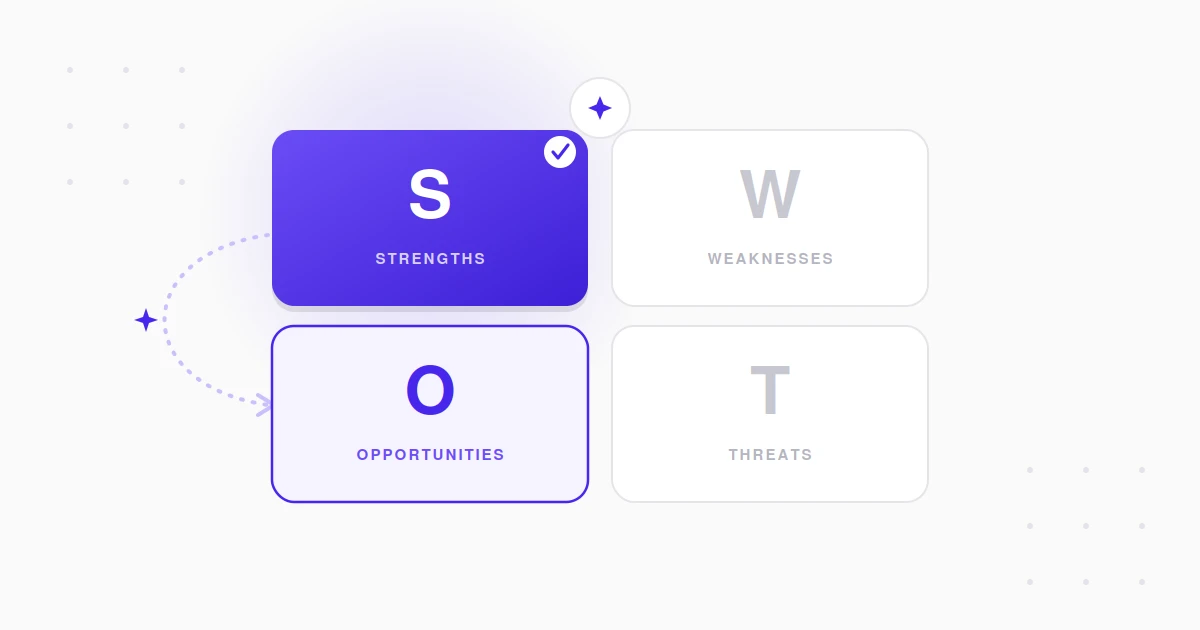
An AI SWOT analysis tool takes a description of your business — your product, market, team, and stage — and generates a Strengths, Weaknesses, Opportunities, Threats breakdown using a language model. The promise is speed: what used to take a strategy workshop now takes two minutes.
The tool landscape splits into three distinct categories, and conflating them is where most founders go wrong:
- General-purpose AI chatbots (ChatGPT, Claude, Gemini, Perplexity) — flexible, good for research and brainstorming, but with no built-in structure or challenge function.
- Visual/diagram SWOT generators (Miro AI, Xtensio, Venngage, MyMap, EdrawMax) — built for fast, formatted 2x2 output you can drop into a deck or share with a co-founder.
- Structured strategy tools (like FounderTools AI's generator, SWOTPal, Jeda.ai) — built specifically to enforce the SWOT/TOWS framework and push back on vague or contradictory input rather than simply accepting it.
Who this applies to
This matters most for founders who are about to use a SWOT to make a real decision — pivoting, prioritizing a roadmap, prepping an investor narrative, or deciding where to spend the next quarter's limited hours.
If you just need a slide for an internal deck with no decision attached, category doesn't matter much. If the output needs to hold up under scrutiny — yours or an investor's — category matters a lot.
Key Considerations
Before picking a tool, understand why generic output happens in the first place. It's rarely the model's fault. It's usually one of three things:
The "Yes Man" problem. General-purpose chatbots are tuned to be agreeable. If you describe your business optimistically, the model mirrors that optimism back as strengths and opportunities instead of stress-testing it. It validates your framing rather than challenging it.
Vague or thin input. "We're an AI startup helping small businesses" gives the model nothing to differentiate on. Specific inputs — customer segment, current revenue, founder background, competitive alternatives — produce specific output. Garbage in, generic out.
List syndrome. Even good input can produce a bad result if the tool just dumps ten items per quadrant with no prioritization. A SWOT with twelve weaknesses is not more useful than one with three. It's just harder to act on.
Here's what to weigh when choosing between the three categories:
| Factor | AI Chatbots | Visual Generators | Structured Strategy Tools |
|---|---|---|---|
| Speed to first draft | Fast | Fastest | Fast |
| Challenges weak assumptions | No — reinforces framing | No — formats what you give it | Often yes, by design |
| Output format | Freeform text | Polished 2x2 grid | Structured grid + prioritization |
| Best for | Early brainstorming, research | Sharing/presenting a draft | A SWOT you'll actually act on |
| Risk | Generic, agreeable output | Looks finished but may be shallow | Requires more upfront input |
Trade-off worth naming: structured tools ask more of you upfront. You'll spend a few extra minutes entering runway, named competitors, and founder background before you get a draft. That's the cost of the sharper output: you're trading a few minutes of speed for output you can actually act on.
How to Approach It: The Input-Prioritize-Cross Framework
Treat the SWOT as a three-pass process, regardless of which tool you use. This is the core framework this article is built around — it works with a chatbot, a visual generator, or a structured tool, and you can run it with pen and paper if you never touch software at all.
Pass one — get specific inputs on the table. Before touching any tool, write down: your actual revenue or user number (even if it's zero), your single biggest customer complaint, the one competitor a prospect mentioned last week, and how many months of runway you have. These four data points alone will pull most tools out of generic territory, because they can't be guessed. They have to be told to the tool.
Pass two — force prioritization. Once you have a draft, cut each quadrant to the top three items ranked by impact. If a structured tool doesn't do this automatically, do it manually. A SWOT that fits on an index card is more useful than one that fills a page, because it forces you to decide what actually matters this quarter.
Pass three — run the TOWS cross-check. A SWOT's real value comes from crossing the four lists into a strategy, not from the lists on their own. Ask: which strength addresses which opportunity? Which weakness makes which threat worse? A tool that only produces the four boxes has done half the job. A tool built for startups should push you toward this cross-analysis, not stop at the grid.
Worked example: applying the framework
Take the pre-seed SaaS founder below. Pass one surfaced four concrete facts: three months of runway, two paying customers, a founder background in dental operations, and Calendly as a named competitor that doesn't serve the vertical. Pass two cut a ten-item draft down to three weaknesses ranked by impact, with runway at the top. Pass three crossed that runway constraint against the opportunity of her operations background, producing one concrete move: use the operations credibility to close two more paying customers before the runway clock forces a harder decision. That's the difference between a grid and a plan.
What to watch for
Don't trust a SWOT that agrees with everything you typed. If every input you gave came back as a strength or opportunity, the tool (or your framing) skipped the challenge function entirely.
Watch for startup-specific blind spots that generic tools miss. Key-person dependency (what happens if you, the founder, are unavailable for a month), founder-market fit, and runway-driven urgency rarely show up in output built for established companies.
Don't confuse a polished export with a good analysis. A visual generator can make a shallow SWOT look authoritative. Judge it by whether the content would survive a skeptical co-founder or investor, not by how clean the PDF looks.
Practical Examples
Illustrative example: pre-seed SaaS founder. A solo founder building a scheduling tool for dental practices typed "We help small businesses manage appointments" into a general chatbot and got back: strength = "innovative technology," weakness = "limited brand awareness," opportunity = "growing SMB market." None of it was wrong, and none of it was usable. On the second pass, she fed in specifics — three months of runway, two paying customers, a founder background in dental operations, and a direct competitor (Calendly) that doesn't serve the vertical. The regenerated weaknesses section flagged runway as the binding constraint and named the key-person risk of her being the only person who understood the sales motion — both things she needed to plan around, not just note.
Illustrative example: seed-stage two-sided marketplace. A founding team used a visual generator to produce a clean SWOT for a board update. It looked complete — four quadrants, evenly filled. But when a board member asked "which of these threats is most likely to hit in the next two quarters," nobody could answer, because the tool never asked them to rank anything. They re-ran the analysis with a structured tool that forced a top-three cut per quadrant, and the resulting one-pager was what actually got discussed in the meeting.
Both examples above are illustrative composites built to show the framework in action, not case studies of named, verified companies.
The pattern in both cases: the tool category didn't fix the problem by itself. Specific inputs plus forced prioritization did. The right tool just makes that discipline easier to apply consistently.
AI SWOT Analysis Tools Compared
AI SWOT tools fall into three groups: structured strategy tools that ask for specific inputs, visual tools that produce diagrams and slides, and general AI assistants. Here is how the main options compare for startup founders. Features change often, so check each product’s site for current plans and pricing.
| Tool | Best for | Strength | Watch-out |
|---|---|---|---|
| FounderTools AI SWOT Analysis Generator | Founders who need a SWOT that drives a decision | Asks for stage, runway, team and named competitors, then returns a prioritised SWOT with an action plan. Free to start. | Needs real inputs; a one-line description gives a weaker result |
| ClickUp Brain | Teams already planning work in ClickUp | Generates a SWOT inside ClickUp docs and whiteboards, next to the tasks that follow from it | Most useful if your team already lives in ClickUp |
| Jeda.ai | Visual, collaborative strategy sessions | Builds SWOT and other strategy matrices on an AI canvas the whole team can edit | A canvas tool first; prioritisation is still up to you |
| MyMap.AI | Quick visual SWOT diagrams | Turns a prompt into a SWOT diagram you can share | Diagram-first; check the content as carefully as the layout |
| Canva | Presentation-ready SWOT slides | Large template library plus AI writing help to fill the quadrants | Design-first; the analysis quality depends entirely on your inputs |
| General AI assistants (ChatGPT, Claude, Perplexity) | Flexible, one-off analysis | Can handle any business; Perplexity can cite web sources for market claims | Tend to produce generic, agreeable SWOTs unless you give specific inputs and ask them to rank |
How to choose: if the SWOT will inform a real decision (a pivot, a raise, quarterly priorities), use a structured tool that forces specific inputs and ranking. If you mainly need a slide for a meeting, a visual tool is faster. Whichever you pick, apply the two-pass method above: give it specifics, then cut each quadrant to the top three items.
Recommended Tools
For most startup founders doing a SWOT that will actually inform a decision, a structured strategy tool built for the SWOT/TOWS framework is the better default over a general chatbot or a pure visual generator. It enforces prioritization and asks for the specific inputs that prevent generic output in the first place.
The trade-off: a structured tool takes a few minutes longer upfront because it asks for real inputs instead of accepting a one-line description. If you only need a quick internal talking point with no real decision riding on it, a chatbot or visual generator will get you there faster.
FounderTools AI's AI SWOT Analysis Generator is built around this: it prompts for the concrete, startup-specific inputs (stage, runway, founder background, named competitors) that produce a usable analysis rather than a template one, and it pushes toward a prioritized top-three-per-quadrant output instead of an unranked list. If you're validating a pivot, prepping for an investor conversation, or setting quarterly priorities, this is a reasonable place to start — with the caveat that no tool replaces the two-pass discipline above. Feed it specifics, and cut the output down to what actually matters before you act on it.
For related groundwork before you run a SWOT, consider pairing this analysis with the AI Competitor Analysis Generator to sharpen your "named competitor" input, or the AI Value Proposition Generator to clarify strengths before you cross-check them against opportunities.
Frequently Asked Questions
What is an AI SWOT analysis tool?
It's software that uses a language model to generate a Strengths, Weaknesses, Opportunities, and Threats breakdown from a description of your business. Quality varies widely — general chatbots tend toward agreeable, generic output, while structured tools built specifically for the framework tend to push back on vague input and prioritize results.
How do I get started with an AI SWOT analysis?
Write down four concrete facts first — current revenue or users, biggest known customer complaint, a named competitor, and your runway in months — before opening any tool. Specific input is the single biggest lever on output quality, more than which tool you choose.
How long does an AI SWOT analysis take?
A first draft from any of the three tool categories takes a few minutes. Getting to a version you'd actually present to a co-founder or investor — with specific inputs and prioritized output — usually takes 20 to 30 minutes across two passes.
What are common mistakes with AI SWOT analysis tools?
The two most common: feeding the tool vague, generic descriptions of the business, which produces vague, generic output, and accepting an unranked list of eight-plus items per quadrant instead of forcing a top-three cut. Both mistakes are about input and follow-through, not the tool's underlying model.
What should I do after completing an AI SWOT analysis?
Run a TOWS cross-check: match strengths to opportunities and weaknesses to threats to identify two or three concrete strategic moves. Treat the grid as a diagnostic step, not the finished plan — the value comes from what you decide to do differently because of it.
Where This Leaves You
Choosing the right AI SWOT tool starts with knowing what you actually need it for. If you're brainstorming loosely, a general chatbot is fine. If you need something polished to share, a visual generator does the job. But if the analysis needs to hold up under real scrutiny — from a co-founder, a board, or yourself before a big decision — a structured tool that forces specific input and prioritized output will get you there faster than a prettier grid will.
The framework holds regardless of tool: get specific before you generate, prioritize after, then cross-check. Apply that discipline with the AI SWOT Analysis Generator and you'll leave with an analysis built to be used, not just filed away.
Sources
This article draws on a review of the current AI SWOT tool landscape, including: (1) general-purpose listicle content covering diagram/whiteboard tools such as Miro, Jeda.ai, Gliffy, Creately, and EdrawMax; (2) standalone free AI SWOT generators (Venngage, Xtensio, MyMap, EdrawMax AI, Evernote, InstantPersonas) and their text-to-2x2-grid output patterns; (3) more critical commentary (SWOTPal, DataGreat) describing the "Yes Man" tendency of general chatbots like ChatGPT, Claude, and Perplexity to validate rather than challenge input, and the case for an "anti-yes-man" stack of framework, research, and critique tools; and (4) startup-specific SWOT guidance (Qubit Capital, Full Scale, Jotform, SWOTPal, siift.ai) covering common startup blind spots such as founder-market fit, runway pressure, key-person dependency, and "list syndrome" (long, unprioritized output). Illustrative examples in this article are composites built to demonstrate the framework, not verified case studies of named companies.
Need a blank template and worked examples? See our SWOT analysis template with 8 complete examples.