Last reviewed: November 2026 · Reviewed by the FounderTools Editorial Team
You're about to raise money, or you think you are, and you have no reliable way to know if your startup would survive a serious investor's first pass. That's the gap AI investor readiness assessment tools are built to close: you upload your pitch deck and some business data, and an algorithm scores how fundable you actually look right now, before a VC tells you no and moves on.
This guide sorts the category into what it actually is, separates it from two things it constantly gets confused with, and gives you a framework for deciding whether to use one, when, and how to read the score without treating it as gospel.
Understanding AI Investor Readiness Assessment Tools
Definition and context
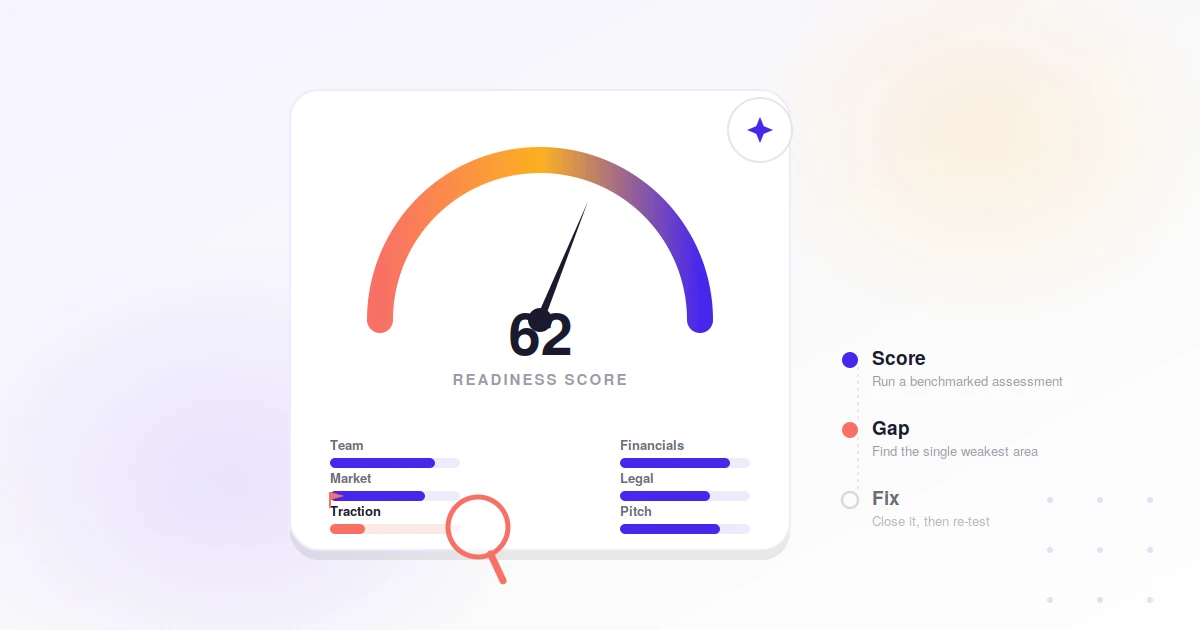
An AI investor readiness assessment tool analyzes your startup's fundraising materials — typically a pitch deck, financial model, cap table, and traction metrics — and returns a numeric score plus a gap analysis across dozens of weighted parameters (market size framing, unit economics clarity, team completeness, legal structure, documentation completeness). Tools in this space, such as ReadyScore, Evalyze, Equisy and Seedscope, position themselves as a faster, cheaper substitute for the informal "does this look fundable" conversation you'd otherwise have with an advisor or mentor.
The category has a naming problem worth flagging directly. Searches for "AI readiness assessment" also surface tools like ANS or Enterprise Knowledge's assessments. Those measure whether a company is ready to adopt AI internally — a completely different question aimed at enterprise IT leaders, not founders raising capital. If a result talks about "AI maturity," "data infrastructure," or "AI governance," it's the wrong category for your search. You want tools scoring investor readiness, not AI adoption readiness.
There's a second, more useful distinction inside the investor-readiness category itself: scoring tools versus deck tools. Platforms like Slidebean, Gamma, and Beautiful.ai are pitch-deck generators. They help you build and design a deck, and some now bolt on AI feedback about slide structure or narrative flow. That's design assistance, focused on how the deck looks. A readiness assessment tool measures something different: whether the business described across your materials would survive investor diligence, regardless of how polished the slides are.
Who this applies to
This applies most directly to founders at pre-seed through Series A who are two to twelve weeks from starting outreach and want an honest, low-stakes gut check before they burn investor relationships on a raise that isn't ready. It's less useful for founders who are eighteen months from any raise — you don't have enough real data yet — or founders already deep in term sheet negotiations, where the tool's job is done and you need a lawyer, not a scorer.
Key Considerations
Before you run your materials through any of these tools, get clear on what you're actually buying and what you're not.
What the score measures. Most tools weight a mix of quantitative signals (revenue, growth rate, burn multiple, runway) and qualitative signals inferred from your deck's language (market sizing logic, competitive differentiation, team bios). ReadyScore, for example, evaluates across more than 40 parameters and returns a score with a specific gap analysis in minutes, a process that would otherwise take a founder weeks of back-and-forth with advisors. Vendors in this category often publish headline success figures. We could not independently verify those figures when we reviewed this guide in November 2026, so treat any such claim as marketing, not as a prediction of your outcome.
What the score does not measure. No AI tool can assess founder-market fit through a five-minute conversation, gauge whether your energy in a room builds investor conviction, or predict how a specific partner at a specific fund will react to your specific thesis. Human investor judgment is relational and idiosyncratic in ways a parameter-based score cannot capture. Treat the AI score as a floor-raiser: it catches structural gaps and missing documentation, which is real, useful work — just not the same work as making your pitch genuinely compelling in the room.
Data and privacy. You're uploading financials, cap table data, and sometimes unreleased product information to a third-party tool. Check the vendor's data retention and deletion policy before uploading anything you wouldn't want cached indefinitely. Avoid uploading materials that include other parties' confidential information — co-founder equity splits with names attached, signed but unannounced LOIs — without checking your existing NDAs.
Cost and access. Pricing varies by vendor and changes often enough that we won't quote current numbers here. Check each tool's own pricing page before committing. Some offer a free or freemium first assessment and charge for the detailed gap report or re-scoring after you've made changes.
Bias and calibration. Any scoring algorithm reflects the assumptions of the data it was trained or calibrated on. If a tool was built primarily around SaaS metrics, it may under-score a hardware, marketplace, or biotech startup whose fundamentals look different by design. Ask, or test, whether a tool's parameter set fits your business model before trusting a low score as evidence something is wrong with your company rather than evidence of a mismatched rubric.
How to Approach It
The Readiness Triage Framework
Use this six-step sequence rather than jumping straight to a tool. It works as a standalone checklist even if you never read the rest of this article:
- Assemble real materials first. A readiness score is only as good as what you feed it. Have a current pitch deck, a 12-to-18-month financial model, a clean cap table, and your key traction metrics (revenue, growth rate, retention, or user numbers) ready before you run an assessment. Scoring a stale or placeholder deck tells you nothing useful.
- Run the assessment and read the gap analysis, not just the score. The number itself is less useful than the specific list of what's missing or weak. A 62/100 with a clear list of five fixable gaps is more actionable than a vague "you scored medium."
- Triage the gaps by effort versus impact. Some gaps are a one-afternoon fix, like adding a slide on unit economics. Others require real work, like finding a second sales channel to de-risk customer concentration. Fix the cheap, high-impact ones first.
- Re-run after material changes, not after cosmetic ones. Reformatting your deck won't move a score built on substance. Only re-assess after you've genuinely changed the underlying numbers or narrative.
- Cross-check the score against one human opinion. Before you rely on the score to decide you're ready, run your updated materials past one advisor, mentor, or angel who has actually raised or invested. This catches the relational and narrative gaps no algorithm sees.
- Time it to your raise, not to a calendar. Run your first assessment about 8–12 weeks before you plan to start investor outreach — early enough to fix structural gaps, late enough that your data reflects your real current state.
Most existing coverage of these tools stops at explaining what the score means, without giving founders a repeatable process for acting on it. The two examples below show the framework applied to two different founders.
What to watch for
Don't mistake a high score for an invitation to skip investor research and warm introductions. A strong readiness score improves your odds inside a good process; it doesn't replace one. Don't use the score as your only editor: founders who chase a higher number by adding jargon or inflating projections are optimizing for the algorithm, not for the investor who will read the actual deck. And don't confuse a matching or introduction feature (some tools now offer investor-matching alongside scoring) with the scoring function itself. Evaluate each capability on its own merits, since a tool can be excellent at scoring and mediocre at matching, or the reverse.
Practical Examples
The following two scenarios are illustrative composites built to demonstrate how the Readiness Triage Framework applies in practice. They are not case studies of named, verified customers.
A seed-stage SaaS founder, four months from raising (illustrative). She runs her deck and financial model through a scoring tool and gets a 58/100, with the gap analysis flagging unclear customer acquisition cost math and no clear answer to "why now." She spends three weeks rebuilding her CAC/LTV slide with real cohort data and adding a market-timing slide grounded in a recent regulatory change in her industry. Re-scored, she hits 74/100 — not because the tool told her what to say, but because it told her precisely where a diligence-minded reader would stop trusting the deck.
A pre-seed marketplace founder who scores poorly and shouldn't (illustrative). He runs an assessment and gets a low score largely because the tool's parameter set assumes SaaS-style monthly recurring revenue, which doesn't map cleanly onto his transaction-based marketplace model. Rather than panicking, he cross-checks with two marketplace-experienced angels, who confirm his fundamentals are sound and the low score reflects a rubric mismatch, not a real weakness. He proceeds with outreach but keeps the tool's structural feedback (his team slide was genuinely thin) and ignores the parts that don't apply to his model.
Both examples point to the same underlying discipline: use the score as a diagnostic input, not a verdict, and always sanity-check it against your specific business model and at least one human who understands your category.
Comparing the Tools
| Tool | What it scores | Notable claim | Watch-out |
|---|---|---|---|
| ReadyScore | A broad startup readiness score across 40+ parameters, including market opportunity and competitive positioning | Built for founders preparing a serious raise; asks for a pitch deck, business documents and multi-year financial projections | Heavier setup than a quick deck check; the effort pays off mainly if you are close to raising |
| Evalyze | Pitch deck analysis with an Investor Readiness Score, plus investor matching by stage, sector and geography | Has a free starter plan; paid plans add more analyses and investor discovery | Scoring and matching are separate features: a strong score does not guarantee a strong investor match |
| Equisy | An AI fundraising platform for startups, investors and accelerators, with investment-readiness tools and data rooms | Useful if you want readiness work and fundraising workflow in one place | A full platform rather than a quick score, so expect more setup |
| Seedscope Investor Readiness Score | A free score built around the signals investors check first | Free and quick, good for a first pass | A lighter check than a full deck review; use it to find gaps, not to predict an outcome |
| FounderTools AI Investor Readiness Assessment | Readiness across your deck, financials, traction and team, with a gap analysis | Free to start; pairs with the AI Pitch Deck Generator to fix the gaps it finds | Like every tool here, it is a diagnostic, not a verdict |
Recommended Tools
If you want a single, structured pass at your own readiness before you commit real cost or time to a scoring tool, FounderTools' AI Investor Readiness Assessment applies a consistent readiness framework to your deck, financials, and traction data and returns a clear gap analysis you can act on immediately. It's free of the SaaS-only bias some third-party scorers carry, and built specifically for founders who are still deciding whether they're actually ready to raise.
Once your readiness gaps are identified, the AI Pitch Deck Generator helps you turn those fixes into an updated, investor-ready deck without starting from a blank page. This is useful specifically for the structural and narrative gaps a readiness assessment tends to surface, such as missing slides, weak sequencing, or unclear market-sizing logic.
Use the two tools together in sequence — assess first, then rebuild — rather than jumping straight to deck design before you know what's actually broken.
The Bottom Line
An AI investor readiness assessment tells you where your fundraising materials have structural gaps, in minutes rather than weeks of informal feedback loops. It's a diagnostic tool, and the judgment of a human who has been through a real raise in your category still does the rest of the work. Use it to triage what's fixable before outreach, cross-check any surprising result against your business model and a knowledgeable advisor, and re-run it only after you've made real changes, not cosmetic ones.
If you're within a few months of starting a raise, run your current materials through the AI Investor Readiness Assessment now. It takes minutes, costs you nothing but the honesty to look at the gaps, and gives you a concrete list to work from before you're in front of an investor who won't tell you what went wrong.
FAQ
What is an AI investor readiness assessment tool?
It's software that scores your startup's fundraising materials — deck, financials, cap table, traction — against dozens of weighted parameters and returns a numeric readiness score plus a specific gap analysis, typically within minutes of upload.
How do I get started with an AI investor readiness assessment?
Gather a current pitch deck, financial model, cap table, and traction metrics first, then run them through a tool like the AI Investor Readiness Assessment. Read the gap analysis in full, not just the headline score, before deciding what to fix.
How long does an investor readiness assessment take?
The scoring itself typically completes in minutes once your materials are uploaded. Acting on the gap analysis — fixing weak slides, tightening financials, addressing missing documentation — usually takes one to four weeks depending on how many gaps surface.
What are common mistakes with AI investor readiness assessment tools?
Treating the score as a final verdict instead of a diagnostic, chasing a higher number with inflated projections instead of real fixes, re-running assessments after only cosmetic changes, and trusting a low score without checking whether the tool's parameter set actually fits your business model.
What should I do after running an investor readiness assessment?
Triage the gaps it surfaces by effort versus impact, fix the highest-impact and lowest-effort items first, cross-check any surprising results with one advisor or investor who knows your category, and only start outreach once you've re-assessed and confirmed real, substantive improvement.
Sources
Tool descriptions were re-checked in November 2026 against each product’s public pages and listings (readyscore.ai, evalyze.ai, Equisy’s Product Hunt listing and seedscope.ai). Features and pricing change often, so confirm current details on each vendor’s site before you rely on them. Vendor-reported success statistics have been removed because they could not be independently verified.
This guide was compiled and reviewed by the FounderTools Editorial Team based on analysis of publicly available investor-readiness and pitch-deck-analysis tools, including ReadyScore, Evalyze, Equisy and Seedscope. Last reviewed November 2026.